Rigorous SDS & classification audit
Our in-house DG specialists verify your Safety Data Sheet against carrier restrictions and port acceptance tables before booking.
Certified multimodal transport and handling of hazardous chemicals, gases, flammable liquids, and lithium batteries.
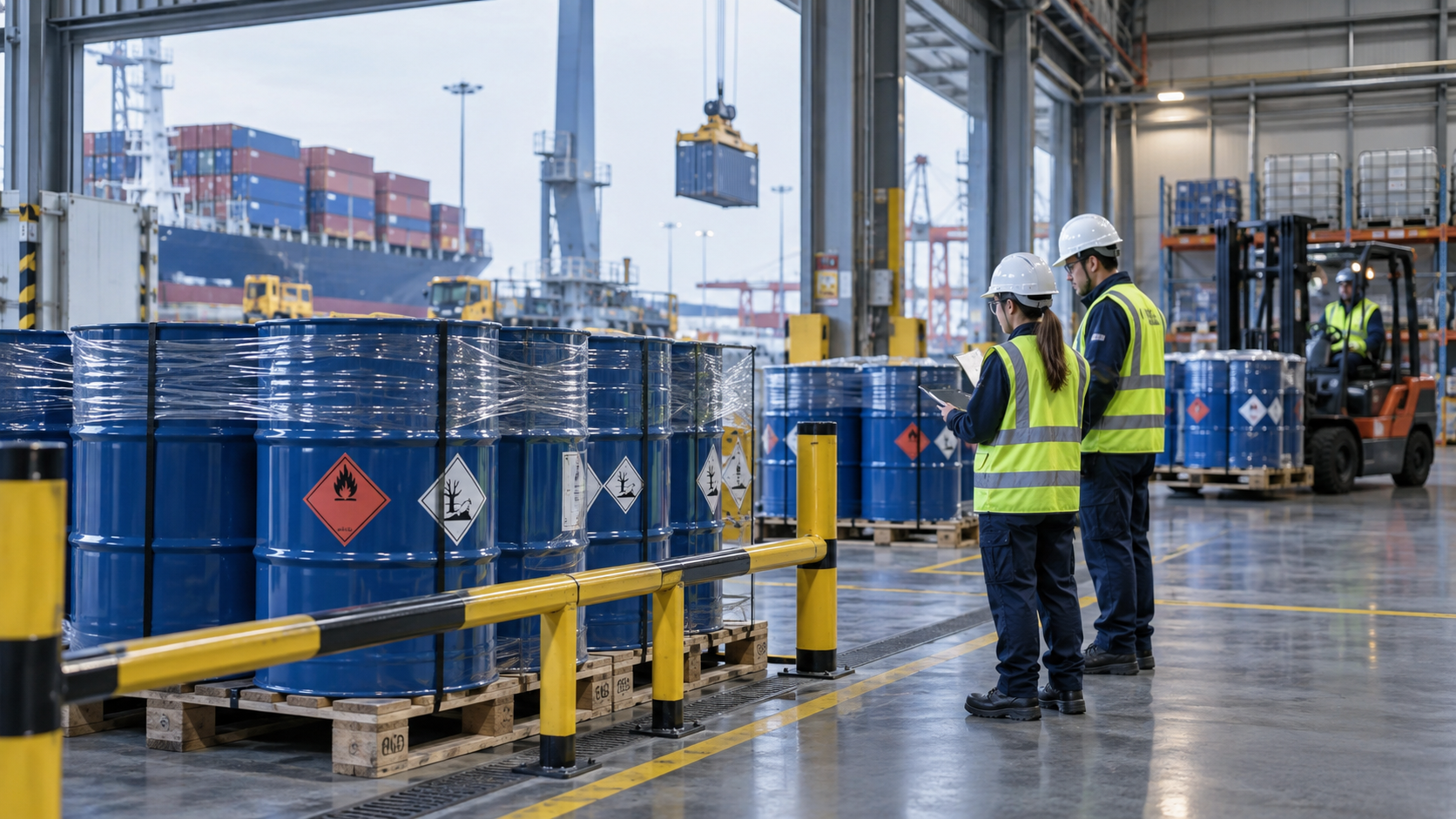
Transporting hazardous materials and dangerous goods requires strict compliance with international conventions and local authority regulations. Interport’s specialized Dangerous Goods (DG) team holds certified accreditation under the IMO International Maritime Dangerous Goods (IMDG) code, ICAO Technical Instructions, and IATA Dangerous Goods Regulations.
We manage the end-to-end supply chain for classified cargo, including chemical raw materials, industrial paints, compressed gases, flammable solvents, corrosive acids, and lithium-ion batteries. From reviewing Safety Data Sheets (SDS) to providing UN-specification packaging, hazard placarding, and port Civil Defence approvals, we ensure total regulatory compliance.
Technical specifications
Standard equipment dimensions, terminal cut-offs, customs systems, and handling capabilities.
| Parameter | Operational standard & compliance |
|---|---|
DG hazard classes handled | Class 2 (Gases)Class 3 (Flammable Liquids)Class 4 (Flammable Solids)Class 5 (Oxidizers)Class 6 (Toxic)Class 8 (Corrosives)Class 9 (Miscellaneous & Lithium Batteries) |
Regulatory accreditations | IMO IMDG Code (Ocean)ICAO/IATA DGR (Air)ADR (Road Transport in GCC) |
Documentation prepared | Dangerous Goods Declaration (DGD)Multi-Modal Dangerous Goods FormContainer Packing Certificate |
Packaging standards | UN-certified packaging (4G boxes1A1 steel drumsintermediate bulk containers / IBCs) with official UN mark |
Local authority approvals | Dubai Civil Defence (DCD) approvalMinistry of Climate Change and Environment (MOCCAE)Dubai Municipality |
Port gate-in protocols | Direct delivery booking to vessel side at Jebel Ali Port to avoid dangerous goods storage surcharges |
Emergency response info | 24-hour emergency contact registration and provision of Emergency Response Guidance (ERG) codes |
Recent SDS (within 3 years) complying with GHS standards showing UN number, Class, and Packing Group
Legally signed declaration certifying proper classification, packaging, and marking
Proof that packaging meets UN performance drop and pressure specifications
Indicating exact net explosive mass or net hazardous quantity per container
DCD or MOCCAE chemical import/export permit where applicable
Core capabilities
Our in-house DG specialists verify your Safety Data Sheet against carrier restrictions and port acceptance tables before booking.
Supply of certified UN hazard boxes, steel drums, absorbent vermiculite, and hazard diamond placards matching your cargo class.
Specialized handling of Section IA, IB, and II lithium ion and lithium metal cells, battery packs, and electric vehicle battery components.
Coordination of specialized transport escorts and immediate container loading at the terminal gate to avoid hazardous demurrage.
Operational questions
Clear answers regarding rates, transit cut-offs, customs, and documentation.
We routinely handle Class 2 (gases), Class 3 (flammable liquids like paints and thinners), Class 4 (flammable solids), Class 5 (oxidizers), Class 6 (toxic substances), Class 8 (corrosives like acids and alkalis), and Class 9 (miscellaneous, including lithium batteries and dry ice). We do not accept Class 1 (explosives) or Class 7 (radioactive material) without pre-cleared government exemptions.
The Safety Data Sheet contains vital technical information in Sections 14 (Transport Information) and 15 (Regulatory Information), including the 4-digit UN Number, Proper Shipping Name, Hazard Class, Packing Group, and Marine Pollutant status, which shipping line dangerous goods desks require before approving vessel space.
UN packaging has passed rigorous physical tests (drop tests, stack tests, and internal pressure tests) certified by a recognized national authority. It is permanently embossed or printed with a UN specification code confirming it can safely contain hazardous materials without leaking during air, sea, or road transport.
No. DP World enforces strict direct-loading rules for dangerous goods. Containers of hazardous cargo must generally be delivered directly to vessel side during a tight 24 to 36-hour cut-off window to prevent hazardous staging inside the terminal.
Book with Interport
Send dimensions, weight, origin, and destination. Our Dubai operations desk will prepare route options and rates, usually within the same working day.